
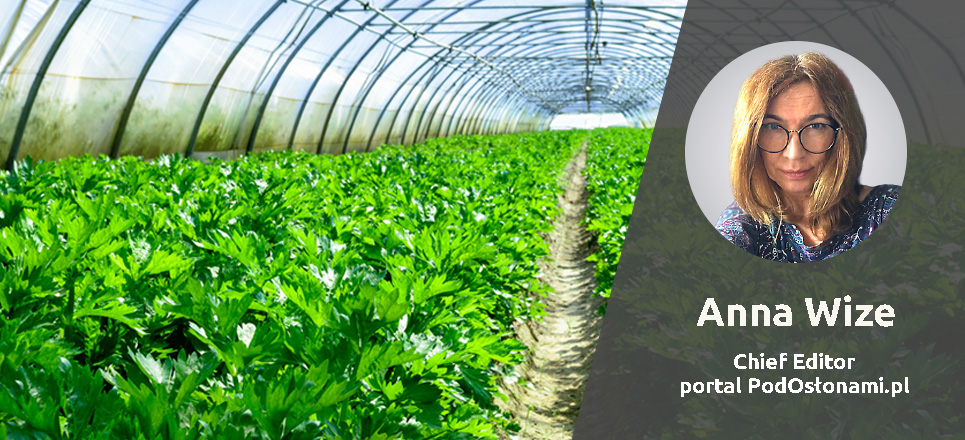
Interview with Anna Wize about the program of the conference "Under Covers. Cultivation in greenhouses, tunnels and indoors – the biggest current threats to plant protection, the future of conservation – 'no residues'".
Ms. Anna, youare the author of the conference program and its moderator. What was the starting point for creatingthisyear's agenda?
First, we areobservingverydynamicchanges in the production of vegetablesundercover– both in Poland and throughout Europe. Today, producersarestruggling with manysimultaneouslyemergingthreats: from newpathogens, throughpestsincreasinglydifficult to control, to the pressure of the market, whichexpects products free of residues and stablesuppliesthroughout the year. I wanted the conference program to be as practical as possible and result from whatproducers face daily. Hence the selection of topics and experts – peoplewhowork in the field, laboratories, consulting and knowwhatchallengesare most urgenttoday.
The conferencewillbegin with a speech Dorota Łabanowska-Bura, PhD on the problems of vegetableprotection in the Radom production region. Whyhasthis region becomeanimportantreference point?
The Radom PepperBasinis one of the largest and most intensively run tunnelvegetableproductioncentres in Poland. It isalso a place whereallthreatsappearearly and with greatstrength– from aphids, throughthrips, to diseasessuch as powderymildeworangular spot. The 2025 seasonhasshownthat the pressure of soilpathogens, the problem of plant deathor developing scleroderma rot arebecomingincreasinglydifficult to control. Łabanowska-Bura's, PhDlecturewilltherefore be a kind of "diagnosing the patient" before we move on to the details of furtherthreats.
The program alsoincludes a speech on the activities of the Plant DiseasesClinic IOR-NRI. Thisis a topicthatrarelyappearsatproductionconferences. Whysuch a choice?
I wanted to show manufacturershowmanydiagnosticfacilities we have in Poland – and how much itisworthusing. Sylwia Stępniewska-Jarosz, PhD, the head of the Clinic, hasbeenobserving for yearswhichpathogens most often end up in laboratories with samples from producers. We seeanincreasingproportion of brooders, anintensepresence of soilpathogens, and anincreasingvariety of viralproblems. Many producersintuitivelysuspect one disease, and itturns out that the causeiscompletelydifferent– orcomplex. We want to show that a correctdiagnosisis the foundation of effectiveprotectiontoday.
Tomatovirusesoccupy a significant place in the program. Isthiscurrently the biggestthreat in greenhouses and tunnels?
Definitelyyes. TomatoFruit Brown BumpVirus (ToBRFV) iscurrently one of the most seriouschallenges in globaltomatoproduction. Thereare no effectivemeans of protection for itafterinfection, and itsease of transmission – even by the hands of employees – meansthatitcandestroyentireplantings. Thatiswhy I invitedtwopeoplewhohavebeenworking on thistopic from differentperspectives for years. Beata Komorowska, PhD, willdiscuss the latestresearchresults, includingthose on the use of stablehypochlorousacid (HOCl), as well as virus diagnostics. On the otherhand, Tomasz Krasowski from Delphawill show the practicalside of growingcrops in the conditions of threatToBRFVorPepMV – from hygiene to the selection of resistantvarieties and the strategy of "grafting" on the mildPepMVbreed. Thisis the knowledgethathasdeterminedwhethermanyfarmsexistor not to exist in recentseasons.
In the second part of the conference, the topic of "zero residue" productionresonatesstrongly. Whyisit a priority for producers in Poland today?
Because the market – especially the foreign market – sends a noticeablyclearsignal: itwants products free of detectableresidues of plant protection products. Chainssuch as Lidl, Edekaor Carrefour offerspecialshelves for "zero residue", and manyproducers from Spain, Italyor the Netherlandsalreadystartedinvesting in thisdirection a fewyears ago. Dorota Łabanowska-Bury, PhD, perfectlyshows the economicaspects of this model: greaterstability of contracts, betterprices, lowerrisk of productrecallsdue to excessresidues.
For Polishproducers, thisis a greatopportunity, but also a challenge – becauseitrequirescomprehensivethinkingabout plant protection, productionhygiene, and control of the entiretechnologicalchain.
The program alsoincludes the topic of plant resistance and theirtolerance to stress. What role doesthisplay in reducingdisease and pestpressure?
Huge. Agnieszka Stępowska, PhD, emphasizesthat a healthy, well-nourished plant islike a person with strongimmunity– itis much moredifficult to infectit. At a timewhen the use of pesticidesisbeingsystematicallyreduced and consumers and chainsaredemandingresidue-free products, itiscrucial to strengthenplants' owndefensemechanisms. It is not only a matter of fertilizationor the substratestructure, but alsosupplementation, biostimulation, and properclimatecontrol. I thinkthislecturewillgiveproducersnumerouspracticaltips.
The conferencewill end with the topic of verticalcultivation – whichstillraisesmanyquestions and skepticism. Didyou want to "disenchant" thistopic?
Definitelyyes. Verticalcultivationis not only a futuristicvision, but a realitythat in somecountriesisalreadyan element of normalproduction. Gabriela Wyżgolik, PhD, – a person whoworks in one of the largest plant factories in Europe – will show whatfactslooklike and wheremythsbegin. It isworthmakingproducersawarethatalthoughitis not a solution for everyone, itisanimportantdirection of development, especially for specializedcropsor micro-leafproduction. Problemsrelated to energy, varietiesor investment costsrequirethoroughdiscussion, not duplication of simplisticopinions.
In youropinion, whatvaluedoes the entireconferencebring to the manufacturersparticipating in TSW 2026?
First, topicality and practicality. Eachlecturefocuses on real problemsthatproducersseesoilpathogens, viruses, pestpressure, growingdemands of recipients. I wanted the participants not only to receive a portion of scientificknowledge, but – tips on how to implementthisknowledge in practice. I believethatproducerswillleave the conference with specificsolutions and a sensethatdespite the challengingtimes, the industryis developing and has real opportunitiesahead of it.
And what do youpersonallylookforward to most duringthisyear'sedition?
What I value the most areconversations with producers – they show whether the program we createreallymeetstheirneeds. I hope for a good, substantivediscussionafter the speeches, becauseitoftengivesrise to innovativeideas and directions of action. TSW is a uniquemeeting place for the entireindustry, and the Under Coverconferenceis one of the fewevents in Poland thatsocomprehensivelyshows the challenges and future of covercrops. I hopethat, as in previousyears, itwill be a dayfull of exchange of experiences.
We are now selling exhibition space at TSW 2027 – the Fruit and Vegetable Industry Fair, which will take place on 14–15 January 2027 in Kielce.
The upcoming edition will be organised in a new hall layout, taking into account the development of the Fair’s infrastructure.Zobacz więcej
Zobacz więcej
Zobacz więcej